
Organizations are investing more in training than ever. As new technology rapidly reshapes employee roles and responsibilities with AI adoption, continuous learning is no longer optional — it’s operationally critical.
But despite this investment, most organizations still face a fundamental gap: they cannot prove who actually understood the training.
Webinars are delivered. Workshops are completed. Documents are shared. Attendance is tracked. Yet none of this answers a simple question:
Who actually understood the material?
Passive attendance is not proof of understanding. Completion is not evidence of competence. And without that proof, it becomes difficult to justify the time, cost, and effort spent on training — let alone measure any real return.
This matters today more than ever. The average cost of a single learning hour now exceeds $150, and compliance failures continue to result in billions in fines globally. At the same time, skills gaps are widening, increasing pressure on organizations to ensure training is not just delivered — but delivers tangible return of investment.
Many teams attempt to address this using existing systems. But in practice, these are often complex, old, time-consuming, and often have very sporadic and low engagement.
The result is a disconnect:
Training is delivered — but understanding is assumed, not verified.
What “training verification” actually means
Most organizations already have training in place. What’s missing is not more content — but an easy and reliable way to verify understanding quickly.
Training verification is not a single feature or a checkbox. It is a system designed to ensure that learning is not only delivered, but proven.
At its core, training verification combines four elements:
- Assessment — validating understanding through questions embedded directly in the training
- Passing criteria — defining what counts as successful completion (e.g. score thresholds, required attempts)
- Certification — issuing a formal outcome when those conditions are met
- Logs and records — capturing structured data such as scores, timestamps, and attempt history
Together, these create an embedded, complete and defensible record of training — not just that it happened, but that it was understood.
This is the key distinction most organizations miss.
Training delivery focuses on distributing content: webinars, videos, documents, workshops. Training verification focuses on proving outcomes: who understood the material, to what level, and under what conditions.
Without verification, training remains an assumption. With it, training becomes measurable, accountable, and auditable.
The implication is simple:
You don’t necessarily need more training — you need to verify proof of understanding.
Why most training systems fail at proof
If the problem is a lack of verifiable understanding — why do so many training systems fail in this regard?
In most cases the issue is not intent, but approach.
The “overbuilt system” problem
Many organizations rely on traditional LMS platforms to manage training. In theory, these systems should provide structure and control. In practice, they are often overbuilt — complex to set up, very difficult to maintain, and have become outdated.
They require heavy configuration, ongoing administration, and continuous oversight. What begins as a solution for delivering training gradually becomes a system that needs to be managed in its own right.
Instead of enabling training, they introduce friction and drudgery.
Complexity reduces perceived value
This friction has a direct impact on the people the system is meant to serve.
One Kwizie customer described it simply:
“If something feels complex, trainees will quickly decide it’s not valuable — just to avoid onboarding another task.”
This is not a minor usability issue — it fundamentally shapes engagement.
When accessing training requires logging into another system, navigating unfamiliar interfaces, or completing additional steps, participants disengage. The perceived value of the training drops, regardless of the quality of the content itself.
The consequence: low adoption and superficial completion
As complexity increases, engagement decreases.
Participants delay or avoid starting training. When they do engage, the goal often shifts from understanding the material to simply completing the requirement. Training becomes a procedural task — something to finish because they have to, rather than something to learn from.
Without meaningful validation, completion becomes a box-ticking exercise, not a reflection of real understanding.
The operational burden behind the scenes
At the same time, the burden shifts to administrators.
Training programs become time-consuming to manage, with systems that grow increasingly cluttered over time. Content versions multiply, reporting requires manual effort, and tracking results often involves exporting and reconciling data across tools.
As one organization put it, managing training can become a full-time job in itself.
The core failure
Across all of these issues, a pattern emerges:
Most systems are designed to manage training — not to prove understanding.
They prioritize delivery, structure, and administration. But they fall short where it matters most: creating quick, seamless, reliable evidence of what participants actually learned.
The result is a system that is complex, underused, and ultimately unable to provide the ROI and effectiveness organizations need.
The training verification model
If most systems fail because they are complex, overbuilt, and focused on managing training rather than proving understanding, the solution is not to add another layer of complexity.
It is to simplify the approach.
Training verification works best when it is applied as a lightweight layer on top of the training that already exists — not as a system that replaces it.
At its core, the model is simple:
Content → Test → Certificate → Proof
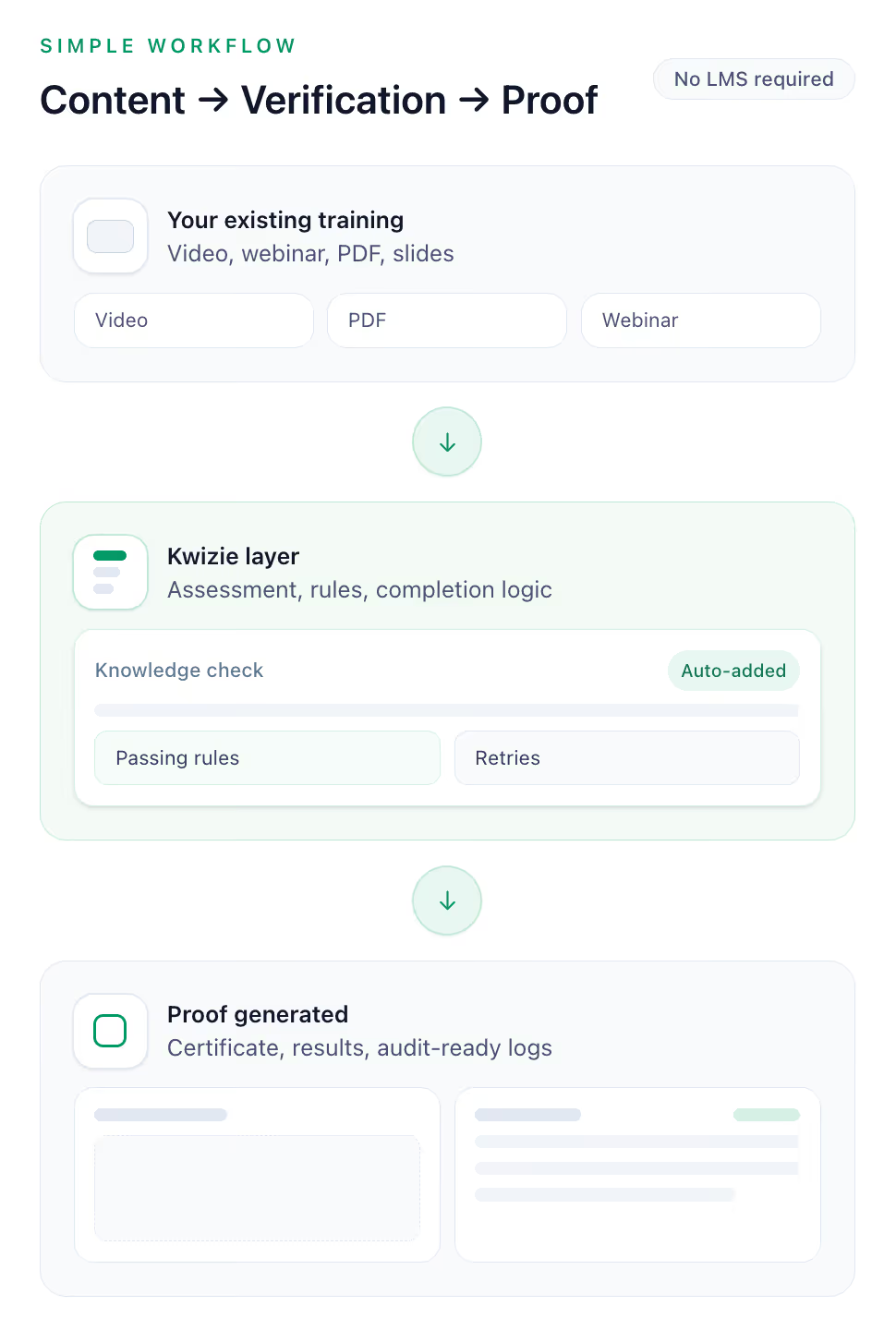
This structure transforms passive training into something measurable and defensible.
Content
The starting point is the training you already have — webinars, videos, documents, slides, or live sessions.
There is no need to rebuild or migrate content into a new system. The goal is to use existing materials as they are.
Test
Assessment is embedded directly into the training itself.
Instead of separating learning and evaluation, participants are validated as they progress. This ensures that understanding is measured in context, not after the fact.
Certificate
Certification is tied to clearly defined conditions.
Participants only receive a certificate when they meet the required criteria — such as passing scores, completed sections, or specific rules set by the organization. This turns certification into a meaningful outcome, not a formality.
Proof
All results are captured as structured, exportable records.
This includes scores, timestamps, attempt history, and completion data — creating a clear and defensible record of what was learned, by whom, and under what conditions.
The strength of this model is not just in its structure, but in how it is applied.
A guiding principle is simplicity.
Training should be frictionless to access and easy to complete. If it feels complex, participants disengage — and verification breaks down. The system only works if people actually use it.
This is where most traditional approaches fail. They introduce complex user interfaces in the name of control, but reduce adoption in the process.
By contrast, a lightweight verification layer increases both participation and reliability. It removes unnecessary steps, reduces administrative burden, and ensures that validation happens as part of the training itself — not as a separate process.
The result is a model that is both simple and scalable:
Training is delivered, understanding is validated, and proof is generated automatically.
What “good proof” looks like
If training verification is the goal, the next question is straightforward:
What actually counts as proof?
In many organizations, “proof” is still based on weak signals — attendance records, completion checkmarks, or manually issued certificates. These indicate that training happened, but they do not demonstrate understanding.
Good proof is different. It is structured, specific, and defensible.
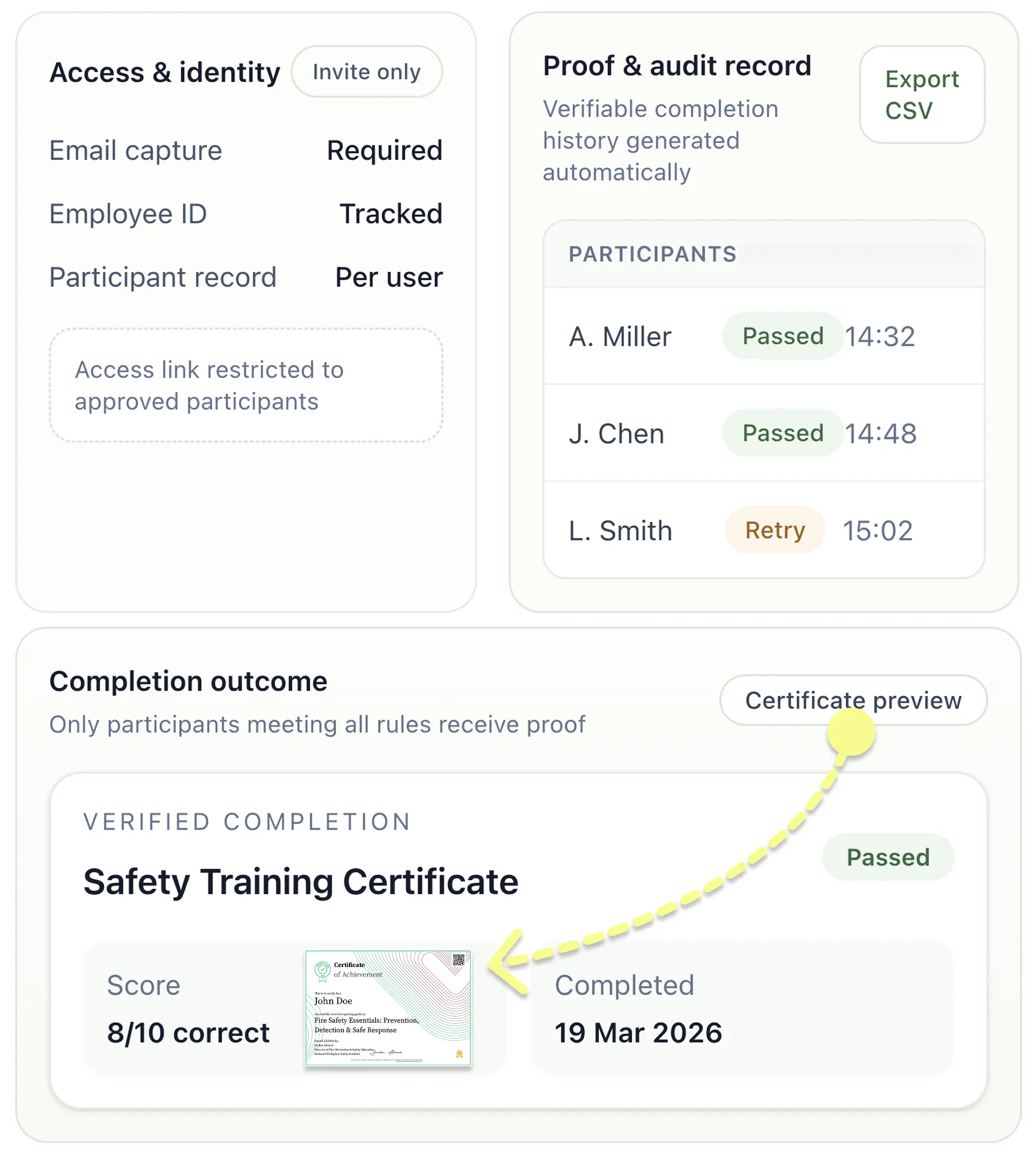
A reliable proof record typically includes:
- Scores — clear evidence of how well the participant performed
- Timestamps — when the training was completed and how long it took
- Attempt history — how many times the participant attempted the assessment and how performance changed
- Identity data — who completed the training, based on defined participant information
- Certificate ID — a unique, verifiable reference tied to the outcome
Together, these elements create a complete picture of the training outcome. Not just that someone attended — but how they performed, under what conditions, and whether they met the required standard.
This is what makes proof defensible.
It can be reviewed, audited, and relied upon — whether for internal tracking, external reporting, or compliance requirements.
By contrast, attendance logs and generic certificates leave too much open to interpretation. They require assumptions. And in high-stakes environments, assumptions are not enough.
For proof to be meaningful, it must be structured, consistent, and tied directly to validated performance.
Anything less is not proof — it’s an approximation.
Real-world applications
Training verification is not limited to a single type of training. It applies anywhere understanding needs to be proven — especially when the stakes are high.
Compliance training
In compliance contexts, proof is essential.
Organizations need to demonstrate that required training was not only completed, but understood. This is particularly important in regulated industries where audits, inspections, or legal scrutiny are common.
With structured verification, each participant’s results are captured with scores, timestamps, and completion data. This creates audit-ready records that can be accessed and exported when needed.
Instead of relying on attendance logs, organizations can provide clear evidence of compliance.
Onboarding and internal training
In onboarding, the challenge is not just delivering information — but ensuring it is understood.
New hires are often required to complete multiple training modules in a short period of time. Without verification, it is difficult to know whether key concepts have been retained.
By embedding validation into the training process, organizations can track progress and confirm understanding at each stage. This reduces gaps in knowledge and creates a more consistent onboarding experience.
It also gives managers visibility into who is ready to move forward — and who may need additional support.
External certification and high-value training
Training verification becomes even more critical when training is delivered externally or tied to certification.
This includes areas such as micro-learning and micro-credentialing programs, where participants complete focused modules to build specific skills. In these cases, certification must reflect real understanding to maintain credibility.
For example, university-style lifelong upskilling programs require participants to demonstrate competence before receiving recognition. Similarly, specialized industries — such as high-end watch authentication — rely on training that validates the ability to detect counterfeit products accurately.
In both cases, the value of the training depends on the strength of the proof behind it.
Across all of these scenarios, the pattern is consistent:
Training is not enough on its own. What matters is the ability to prove that learning has taken place.
This is what makes training verification broadly applicable — and increasingly necessary.
How to implement training verification
Implementing training verification does not require rebuilding your training programs or introducing complex systems.
In most cases, it can be applied directly to the training you already have.
The process can be broken down into a few practical steps:
1. Use your existing content
Start with what already exists — webinars, videos, documents, or live sessions.

There is no need to migrate or recreate materials. The goal is to layer verification onto current training, not replace it.
2. Define clear passing criteria
Set explicit rules for what counts as successful completion.
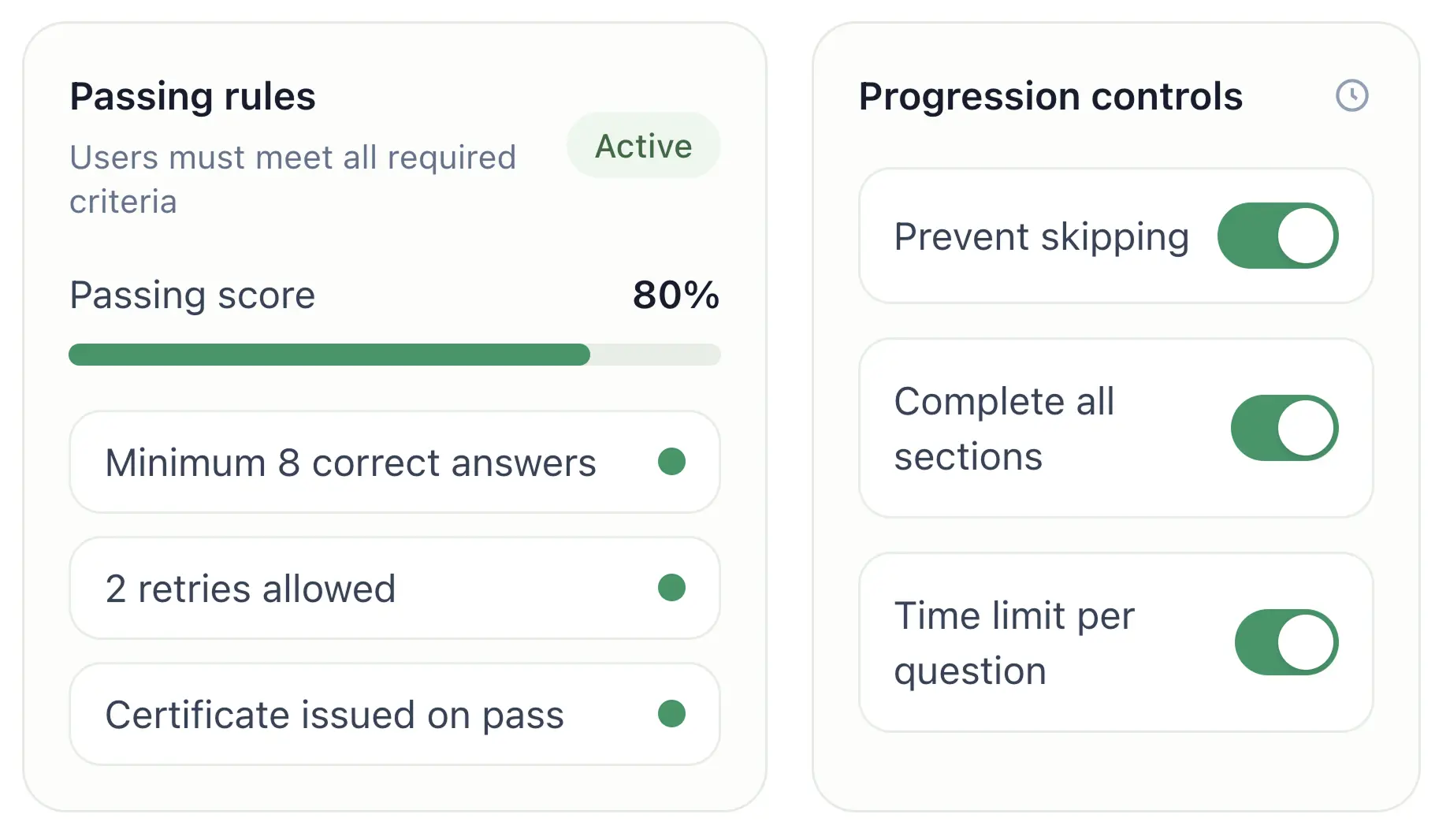
This may include score thresholds, required sections, or limits on attempts. Clear criteria ensure that certification reflects real understanding, not just participation.
3. Embed assessment into the training
Add validation directly into the training experience.

This can take the form of questions placed throughout the content, ensuring that participants are assessed as they progress — not only at the end. This keeps validation contextual and continuous.
4. Set access and participation rules
Define how participants access the training and how their identity is captured.
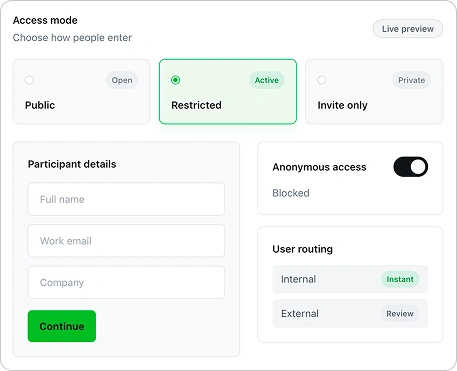
This can range from open access with basic details, to more controlled environments where specific participant information is required. The goal is to ensure that results are tied to the right individual.
5. Track and export structured results
Ensure that all outcomes are recorded in a structured way.
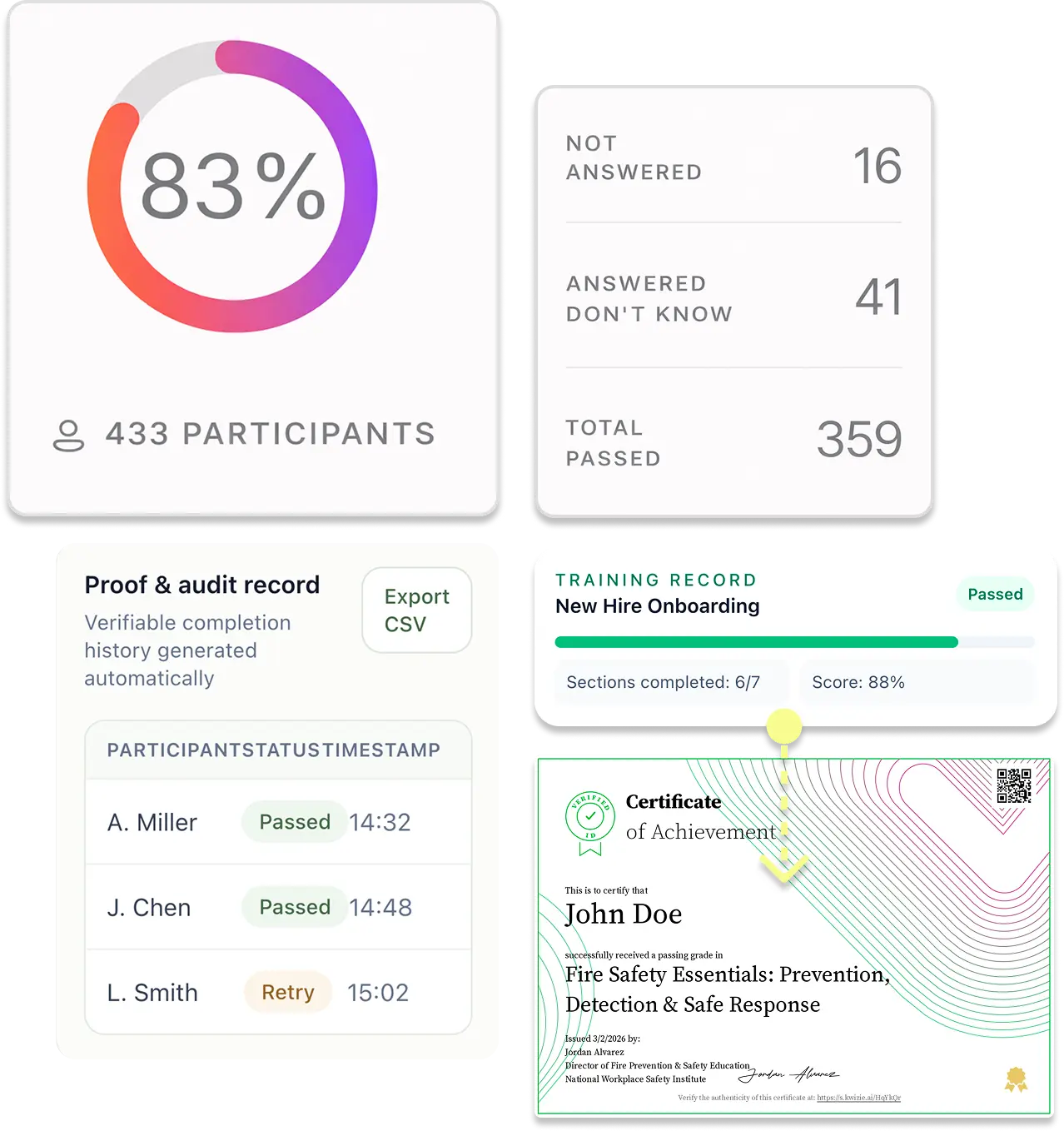
Scores, timestamps, attempt history, and participant data should be captured automatically and made available for export. This creates a reliable record that can be used for reporting, audits, or internal review.
The effectiveness of this process depends on one key principle:
The simpler and quicker the system, the higher the adoption — and the stronger the proof.
When training is easy to access and complete, participation increases. When participation increases, validation becomes meaningful.
This is what makes training verification practical and scalable:
It works with what you already have, requires minimal overhead, and produces reliable proof by design.
Lightweight verification vs. traditional LMS
Most organizations are familiar with learning management systems (LMS). These platforms are designed to act as systems of record — centralizing content, tracking participation, and managing training programs at scale.
In theory, this provides structure and control. In practice, it often introduces friction, complexity and drudgery.
LMS platforms are typically heavy, admin-driven systems. They require setup, configuration, and ongoing management. Over time, they become environments that need to be maintained — rather than tools that simply enable training.
Training verification takes a different approach.
Instead of managing training, it focuses on proving outcomes.
Rather than replacing existing systems or requiring content migration, a verification layer sits directly on top of the training itself. It embeds assessment, defines completion criteria, and generates structured proof — without adding unnecessary overhead.
This makes it lightweight by design.
One Kwizie customer summarized this distinction clearly:
“Kwizie nails the balance of simplicity on the front end with sophistication under the hood — that’s a big differentiator versus overbuilt LMS products.” Anthony Fabiano — Watch Certification Services of America
This balance is critical.
By reducing friction for participants while maintaining rigor in validation, verification becomes something that is actually used — not avoided.
The result is not a better LMS.
It is a different approach entirely: one that prioritizes proof over process, and outcomes over administration.
Training without proof is incomplete
Training plays a critical role in how organizations operate, adapt, and grow. But without proof of understanding, its impact remains uncertain.
Attendance does not demonstrate competence. Completion does not guarantee learning. Without verification, training is difficult to measure, justify, or rely on.
Training verification changes this.
By combining assessment, clear criteria, certification, and structured records, it turns training into something measurable, defensible, and actionable — without adding unnecessary complexity.
The most effective systems are not the most complex. They are the ones people actually use.
When verification is simple and embedded into the training itself, adoption increases — and proof becomes reliable by design.
