How to Test Employees After Training
A practical guide to post-training assessment: what to test, when to test it, how to set pass criteria, and what evidence to keep.
Updated May 31, 2026
Training is easy to count and hard to verify. A webinar can show attendance, a video platform can show watch time, and an LMS can mark a module complete. But for teams responsible for safety, compliance, onboarding, customer operations, or regulated procedures, those signals answer only the first question: did someone show up?
The more useful question is whether the employee can apply what they learned when it matters. That is why post-training testing should be designed as evidence, not as a token quiz at the end of a course.
This guide explains how to design a practical assessment that helps managers see what landed, gives learners a better chance to retain the material, and creates records that still make sense during an audit or internal review.
Start with the risk, not the quiz
The first mistake is writing questions before defining what the assessment is supposed to prove. For most workplace training, the goal is not trivia recall. The goal is confidence that an employee can avoid a costly mistake, follow a required process, or perform a task to an acceptable standard.
Before creating questions, define three things:
- Critical knowledge: What must the employee remember without help?
- Critical decisions: What situations require the employee to choose the right action?
- Critical evidence: What record would satisfy a manager, auditor, customer, or regulator?
This framing is useful because different training types need different proof. For compliance training, the evidence may be a completion record, score, timestamp, and version of the policy trained. For safety training, a quiz may be insufficient unless the employee also demonstrates safe behavior or tool handling. For onboarding, the assessment may focus on whether a new hire can apply internal processes without repeated supervision.
The CDC’s guidance on training effectiveness makes a similar distinction: training should be evaluated not only for learning, but also for whether learners can transfer what they learned back to the workplace.
Use a simple evidence ladder
A helpful way to design post-training testing is to think in levels of evidence:
- Attendance: The employee was present or opened the material.
- Engagement: The employee interacted with the material.
- Knowledge: The employee answered questions about the material.
- Application: The employee solved realistic scenarios or demonstrated a task.
- Transfer: The employee applied the behavior correctly later in the workplace.
Many organizations stop at level 1 or 2 because those are easiest to capture. But completion and watch time do not prove understanding. For high-stakes training, the minimum useful evidence is usually level 3, and the best evidence often combines level 3 with level 4 or 5.
This maps well to the widely used Kirkpatrick evaluation model: reaction, learning, behavior, and results. A post-training quiz mainly measures learning. Scenario questions and observed demonstrations get closer to behavior. Business or compliance outcomes, such as fewer incidents or fewer process errors, are results.
Write questions that test judgment
Multiple-choice questions are not the problem. Weak multiple-choice questions are.
A weak question asks the learner to repeat a phrase from the training:
What is the required reporting deadline?
A stronger question puts the learner in a realistic situation:
A customer reports a data issue at 16:30 on Friday. The responsible manager is offline. What should you do first?
The second version is better because it tests whether the employee can recognize the right action under realistic constraints.
Use a mix of question types:
- Recall questions for facts employees must know quickly.
- Scenario questions for judgment, escalation paths, and exceptions.
- Ordering questions for procedures that must happen in sequence.
- Spot-the-risk questions for safety, compliance, quality, and security training.
- Short answer or supervisor check-offs when guessing would make the result meaningless.
Research on retrieval practice is relevant here. A 2021 systematic review in Educational Psychology Review found consistent benefits from asking learners to retrieve information from memory rather than only restudying it. In plain language: testing is not only a measurement tool. When designed well, it can also improve retention.
Place questions inside the training
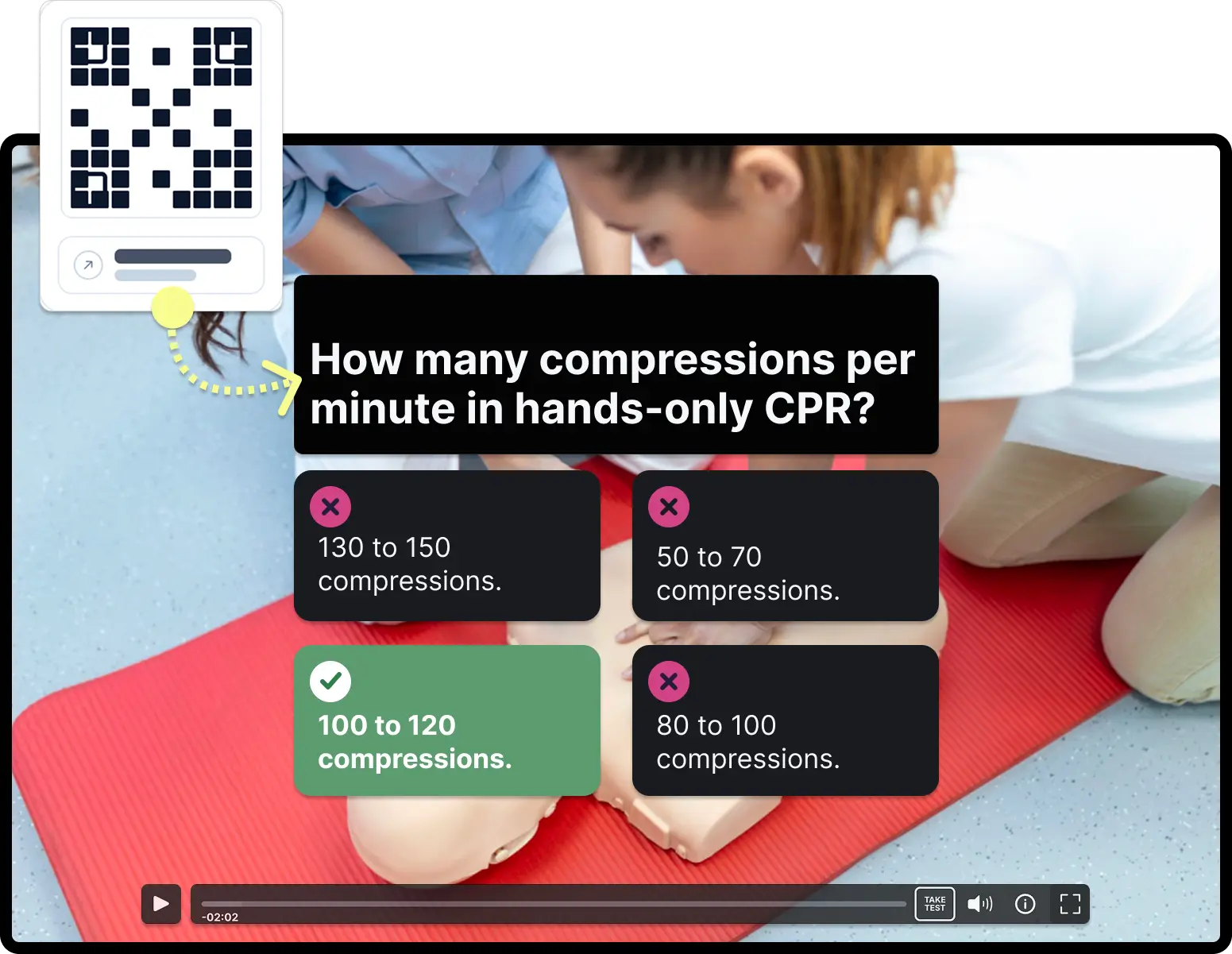
End-of-course tests are useful, but they often reveal misunderstanding after the learner has already moved through the material. Embedded questions solve a different problem: they check understanding at the point where confusion is likely to occur.
Good places to add questions include:
- After a safety-critical instruction
- After a policy exception
- After a process handoff between teams
- Before a learner can proceed to a certificate
- After a video segment where people commonly skip or multitask

Set pass criteria before employees take the test
A post-training test needs clear rules. Otherwise, the organization ends up debating the result after the fact.
Define:
- The minimum passing score
- Whether all critical questions must be answered correctly
- How many attempts are allowed
- Whether answers are shown after each attempt
- Whether a manager is notified after failure
- How long the certification remains valid
Not every question should carry the same weight. A learner who misses a low-risk terminology question may still pass. A learner who misses the emergency shutoff procedure, data breach escalation step, or patient safety rule may need retraining even if the overall score is high.
Keep records that explain the result
A useful completion record should be understandable months later by someone who was not involved in the training.
At minimum, keep:
- Employee name or identifier
- Training title and version
- Completion date and timestamp
- Score and pass/fail status
- Attempt history
- Certificate ID, if issued
- Question-level results for critical items
- Evidence of any practical demonstration, if required
For safety training, OSHA emphasizes that required training must be provided in language and vocabulary employees can understand. That matters for assessment too: a passing record is more credible when the test was accessible to the learner and aligned with the training language.

Use follow-up checks for behavior change
A quiz immediately after training can show short-term learning. It cannot always show whether behavior changed on the job. For higher-risk workflows, add a delayed check.
This can be lightweight:
- A supervisor observation one week later
- A spot check against real work output
- A refresher question sent after 30 days
- A review of incident, error, or rework data
- A short scenario assessment after employees have used the process
The CDC notes that delayed evaluation is often the best way to assess learning transfer because employees have had time to apply what they learned. That does not mean every training needs a complex evaluation program. It means the assessment should match the risk.
A practical template
For most workplace training, this structure is enough:
- Define the job outcome: What should the employee be able to do or avoid?
- Identify critical points: Which mistakes create real risk?
- Create scenario-based questions: Test decisions, not only definitions.
- Add embedded checks: Place questions after the most important sections.
- Set pass rules: Decide score, attempts, critical questions, and certificate logic.
- Store evidence: Keep score, timestamp, version, attempt history, and certificate ID.
- Follow up when needed: Use supervisor checks or delayed assessments for behavior change.
The result is a training program that does more than mark people complete. It helps managers find weak spots, gives learners a better chance to retain the material, and creates records that can stand up later.
References
- CDC: Evaluate Training: Measuring Effectiveness
- OSHA: Compliance Guidance on Training
- Yang et al., Retrieval Practice Consistently Benefits Student Learning, Educational Psychology Review
- Pastotter and Bauml, Retrieval Practice Enhances New Learning
- NIST SP 800-50r1: Building a Cybersecurity and Privacy Learning Program
Use your existing training. Add proof in minutes.